I browsed the Rethinking Schools archive searching for something regarding disabilities because my Teach Out Project is geared towards that topic. I found the Spring 2021 Volume 35, No. 3, Toward Disability Justice. The article I read within this volume is The Story of One Union’s Journey Toward Disability Justice by Emma Fialka-Feldman.
Emma wrote a very informative and touching piece about the importance of prioritizing inclusion through teaching unions. Emma is an elementary educator in Boston Public Schools (BPS). Her passion for educating and civil rights stemmed from her brother, Micah, who has a mental disability that was not disclosed in the article. Micah's disability is very limiting in that he can't count change, can only spell his name and is unable to read. Despite his intellectual capacity, Micah is a Teachers Assistant in Syracuse training future teachers! A key concept Emma repeated was, "learning is a life long process" and thus, learning did not hinder his skill set. This reminded me of a movie I watched for my last class, CEP 552, This is Not About Me. It told the impressive story about an autistic woman named Jordyn that was unable to communicate. She was seen as unintelligent and combative, which had a negative impact on her academically and socially. When she turned 18 years old, everything changed. Despite her K-12 struggles, she went on to earn her bachelors in education policy and her masters in education and business administration. She is an incredible educator and disability advocate. You can purchase the movie here.
It's interesting to compare the movie with this article because both Micah and Jordyn are part of the ADA generation; those who came of age since the passage of Americans with Disabilities (ADA) in 1990. This didn't help Jordyn's story but it made Micah's story less difficult and accessible. I can't help but wonder if it's due to the privilege Micah earned from his parents. Emma acknowledges that they were raised with privilege being from a white, middle class, college educated and married, heterosexual family. If I recall correctly, Jordyn lived with her mom in a lower class community. Additionally, Micah's parents fought tooth and nail for his inclusion in school. “Micah wouldn’t go to school to become less disabled. Micah would go to school so that he could reach his full potential. Learning and developing would be a lifelong process. Micah deserved to learn alongside his neighbors and friends with and without disabilities". Jordyn's mom also believed in her, but her voice was never truly heard; further proving that privilege has power.
Interestingly enough, Emma explains that Micah did reap the benefits of the Public Law 94-142 of 1975 which allowed students with disabilities to be in free, mainstream, public schools. “The values that guided the passage of the ADA intersect with the inclusive education movement that demands people with disabilities not simply be allowed to go to a segregated school (based on disability), but that the structures and policies in our communities be accessible and barrier free". Prior to this, instead of an academic curriculum, people with disabilities were put into mental institutions that focused on a "medical model that prioritized compliance and low expectations over learning and community". He went into K-12 with an opportunity that was previously unavailable. "Laws alone do not guarantee access, but they begin to open doors".
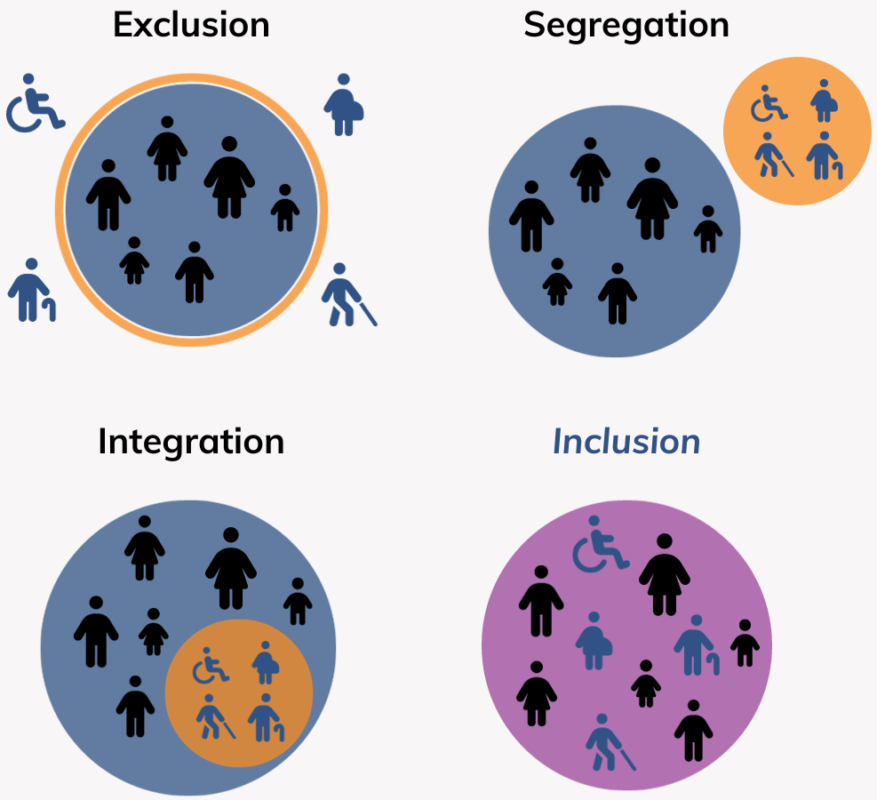
Emma became an inclusion teacher in BPS in 2013 and joined their Boston Teachers Union (BTU) Inclusion Committee in 2017. Inclusion teachers (IT) work in inclusive classrooms (IC). IC "ensures that students with disabilities are held to high standards and given access to more opportunities”. They consist of a proportioned number of students with and without disabilities. When Emma started working, there was typically one teacher with multiple, sometimes three, licenses and one paraprofessional for 20 students. There were up to 5 students with special needs integrated with able bodied students in each class. This design left educators feeling “ill-prepared and inadequate” because they didn’t have the support needed. Emma saw these structural conditions and feared parents and educators would develop a negative idea about inclusive classrooms. She saw the importance of inclusivity first hand with Micah, so she needed to make a change. Emma’s idea of inclusive classrooms was structured around these 3 questions: 1) Do students with disabilities and without disabilities have the support they need to grow academically and socially? 2) Do adults have the supports they need to meet students’ needs? and 3) Is the inclusion classroom promoting high expectations and a belief in what is possible?"
Emma took these questions and had conversations with other educators in her district. She identified racial inequities from them. “According to the National Council on Disability in 2018, students of color with disabilities are less likely to be in inclusive classrooms than white students. When the location of a school district is factored in, these statistics widen dramatically. These statistics were on loud display in Boston”. Emma was appalled by the injustices and racism around inclusion, which is why she joined the inclusion committee. She explained that “this committee’s initial work helped me, as a young teacher, to realize that unions could be leaders in the fight for inclusive education".
Emma saw firsthand the shift that teachers unions have a more social justice approach meaning the teaching and learning conditions are priority, in addition to making sure all students have access to the schools they deserve. Previously, they were more service-driven meaning they focused on protecting wages and benefits. This shift is what led the BTU to form the Inclusion Committee instead of eliminating the inclusion classrooms entirely because the teachers were unsupported and stretched thin. The BTU gathered data to support the “specific demand to stop triple-certifying teachers as a cost-saving measure and instead put two teachers in each inclusion classroom to meet student needs“. The teachers wanted to be an end to limitations from those without resources or privilege. The believed "inclusion done right would be the expectation for all kids, especially students of color and others often excluded”.
The movement was called Inclusion Done Right (IDR) and it had several small victories in the 2019 contract negotiation; but made big waves for future changes. For example, students who required English learner services now had to have support from another teacher besides their triple-certified classroom teacher, and those who had resource room minutes in their IEP must also have their minutes met from a teacher other than their classroom teacher. As momentum built from the IDR campaign, the BTU meetings in 2019 and 2020 gained a lot of popularity. In a room with 75 seats, each was taken by a staff or family member. The meetings offered interpretive services and childcare, making them more accessible than ever. Then, the pandemic hit and the tragic story of George Floyd scoured the nation. The BTU began a new campaign under the IDR, "Building an Anti-Racist Union". called for the removal of cops in our schools, the inclusion of ethnic studies curriculum, making the Black Lives Matter at School Week of Action part of the job description of building reps, keeping a union Truth and Reconciliation Committee to address racism that has persisted in the union for generations and healing, and creating a statement about the Inclusion Done Right campaign“. The campaign was successful and was passed in its entirety.
In response to the approval, BTU member Natalia Cuadra-Saez said, “when BTU members voted to pass the Resolution for Building an Anti-Racist Union it felt like a historic moment. To me it’s part of a historic shift that is happening within the labor movement. More and more unions and rank-and-file members are embracing a social justice unionism model. We’re acknowledging as union members that our goal is not just to fight for economic justice, but also for racial justice and social justice as a whole. To include demands from the Inclusion Done Right campaign is part of that acknowledgement. Inclusion Done Right is a civil rights issue. Inclusion Done Right is a racial justice issue. And if we want to build an anti-racist union we know that we can’t just use buzzwords or wear a sticker. We need bold demands that tackle the systemic inequalities our members, students, and families deal with on a daily basis. Inclusion Done Right is one of those bold demands". This statement, and entire article, was incredibly powerful.
This article relates to all of the topics we have discussed this semester but I couldn't help but see the similarities with the movie we watched last week, Precious Knowledge, and the DEI articles. I fear I see a trend about to happen. The ethnic studies classes were taken away from the students in Tucson Arizona despite their tremendous success. It was a huge step backwards. I worry that with what's going on with DEI, that same will happen with special education. The progress that has been made is too important to revert from.


Your choice of article was so interesting, I love that the author wants to bring to light the way that the education system views disabilities and certainly underestimates the individuals with those disabilities. Just because someone's learning ability doesn't look like someone else's does not mean they are not capable of amazing things.
ReplyDeleteThis is excellent, Sam. I am absolutely stealing that image of inclusion vs segreation etc to use in future teaching! Sounds like you ot a lot out of this.
ReplyDelete