Thursday, June 26, 2025

Thursday, June 19, 2025
Reflecting on Language and Power
Virginia Collier’s Teaching Multilingual Children emphasizes the importance of valuing students’ native languages and cultures in educational settings. Collier argues that an educational environment where English replaces a child’s first language, actually harms academic growth and cultural identity. Instead, she advocates for bilingualism. "The key is the true appreciation of the different linguistic and cultural values that students bring to the classroom" and "appreciating student's different languages and life situations". This concept basically maintains and develops the home language to enhance learning. She highlights that language is inseparable from identity and self-worth.
Lisa Delpit’s The Silenced Dialogue complements Collier’s ideas by highlighting how power dynamics in schools often marginalize students of color and non-mainstream linguistic backgrounds. Delpit argues that teachers must acknowledge and bridge cultural gaps without silencing students’ voices. These connections highlight the urgent need for culturally responsive pedagogy that both honors students’ linguistic heritage and prepares them to navigate dominant discourses. Together, the author's advocate for inclusive practices that affirm rather than erase diversity. I found this article that emphasizes how bilingual education benefits students, check it out here.
In Aria, Richard Rodriguez reflects on his experience of transitioning from his Spanish language at home to English at school. While the English language gave him academic success, it distanced him from his family and cultural roots. Virginia Collier’s article directly challenges this model, advocating instead for bilingualism where both languages are nurtured. I find Collier's ideas to be extremely true in my quest to teach my daughter Cora American Sign Language and spoken English. I truly hope I can find a way to nurture her home ASL language as she grows and enters the school system.
Since learning Cora was profoundly deaf, I began learning the language of ASL and slowly incorporating it into my day to day routine. Cora was only a newborn but as time went on, it became more natural for myself and I could see how receptive she was to my gestures. She started signing at 6 months old and by the time she received cochlear implants at 9 months old, she knew around 60 signs. Her acquisition of ASL continued to develop while she waited for her implants to be activated at 10 months. Her ear's were activated at a very low sound so that it didn't overwhelm her and gave her brain time to recognize the new world around her. Cora can now sign over 150 gestures and uses them in combination such as "where red ball" or "daddy home later". Additionally, her home language of ASL has made her spoken language acquisition easier and faster! Since she already had a foundation of language, she was able to make the connections to spoken language. Cora can speak over 30 words and is actually ahead of her speech and language development for her age. It is remarkable being able to communicate accurately with an 18 month old. I am not only a huge advocate for ASL because it is my community now, but I am a huge advocate for all children. Some kids don't start speaking until after 2 years old and utilizing ASL is so beneficial for giving them autonomy.
I had totally forgot about the web videos we needed to watch so I thought my blog was finished😆. I'm glad that I had already formulated the connections to the readings with my daughter because watching episodes 1, 2, and 3 of Teaching Bilinguals (Even if You’re Not One) from the CUNY-NYSIEB webseries really resonated with our journey to bilingualism. The series encourages people to reframe how we view emergent bilinguals. They are not students in need of correcting, they are learners with rich linguistic and cultural assets. Episode 1 introduces the term “emergent bilingual” to honor students’ multilingual development. Episode 2 explores how multilingualism enriches classroom learning and how to advocate for these students, while Episode 3 highlights translanguaging as an incredible way to build understanding and identity through the students development of graphic novels.
These episodes deeply resonate with my personal journey and how we are navigating a bilingual path that honors her full communication needs. Like the students in the webseries, she thrives when both of her languages are seen as strengths—not when she is forced to choose one over the other. The series reminds me that all children, including those with disabilities, deserve educational spaces where their languages and identities are affirmed. Translanguaging, whether through ASL and speech or other language combinations, is not just a method, it’s a right and a powerful form of inclusion
 |
| Watch Me Change The World |
Monday, June 16, 2025
Final Project Article Summaries
In Other People’s Children: Cultural Conflict in the Classroom, Lisa Delpit explores the cultural disconnect that predominantly white, mainstream educators face when working with students from marginalized communities and diverse backgrounds. She challenges the idea that progressive, process based educational approaches are not as universally beneficial as we hoped. She explains that even the most well-intentioned teaching methods can overlook the cultural norms and communication styles valued in the diverse student population. Instead, she introduces the idea of inclusive pedagogy to undermine systemic inequities. Delpit advocates for educators to become more aware of the "codes of power" that control academic success in order to reshape the experiences of marginalized students. She believes creating an environment where students' home cultures are respected and integrated into learning, will empower all students to succeed. Overall, she is encouraging educators to critically reflect on their own practices and biases to promote an inclusive classroom.
In The Academic and Social Value of Ethnic Studies: A Research Review, Christine E. Sleeter provides evidence from extensive research that proves ethnic studies courses positively impact student's academic and social performance. Ethnic studies is a curriculum that focuses on experiences, cultures and perspectives of historically marginalized racial and ethnic groups. Sleeter challenges the misconception that these courses are divisive. Instead, she explains how these courses provide greater student engagement because when students see themselves reflected in their learning, they are more motivated and determined to succeed. Overall, Sleeter is bringing awareness to the importance of utilizing other teaching strategies to create more inclusive classrooms.
Reflecting on Sex and Gender
This weeks articles by the Trevor Project and RI Department of Elementary and Secondary Education were very informative. I appreciated how the RIDE focused on working together to foster safe and inclusive education environment. They began the document by stating, it is "imperative that the school system, along with family and education professionals, be supportive role models and advocates for the safety and well-being of children". They gave shocking and alarming data that showed 42% and 40% of gender non-conforming students reported bullying and being excluded. This highlights the urgency and need for teamwork. All children deserve to feel safe and included, and if they are hurt or embarrassed, it will interfere with their ability to focus and retain information in class.
Additionally, RIDE reports that "in May, 2001, Rhode Island became the second state in the country to explicitly prohibit discrimination on the basis of gender identity or expression, thereby protecting transgender people from discrimination in employment, housing, credit, and public accommodations". It is wonderful that awareness is being brought up regarding these topics but the statistics are still disturbing. Furthermore, it is not surprising that kids report being bullied or feeling suicidal because of their gender non-conformity when students of diverse backgrounds or low socioeconomic status are also excluded and made fun of. The battle against race and finance has been going on much longer than sex and gender issues. I don't know what the solution is but I fear we are not even close to finding one yet.
I also really liked how RIDE and the Trevor Project gave specific examples of best practices to help make transgender and nonbinary students feel welcomed and supported. For example, RIDE gave detailed instructions on how certified school nurse teachers should handle medical documents and protecting confidentiality. "In the case of a transgender student, a school nurse should use the student’s preferred name, and should use the student’s birth name only when necessary to ensure that the student receives appropriate care and to enable the school nurse to coordinate care for the student with other health care providers or licensed professionals, as well as to file health insurance claims". This is really important information for myself because I am a nurse. Another best practice that I appreciated was the misgendering topic in the Trevor Project article. I can definitely understand how hurtful it could be being called the wrong pronoun even if it is an honest mistake. I value the importance of how we start our classes with the moo in even more now. With frequent reminders of how someone wants to be referred to, it can help to prevent mistakes.
The author, RI Department of Elementary and Secondary Education, argues that gender non-conforming youth are subjected to bullying and segregation that cause mental health issues and suicidal ideation. They provide guidance based on state and federal laws that encourage an inclusive environment, reduce stigmatizing and promote communication.
The author, The Trevor Project, argues that transgender and nonbinary people are misunderstood and provides clear, simple explanations to becoming an ally to them.
Wednesday, June 11, 2025
Teach Out Proposal
Inclusive Education: Supporting HOH Children Academically and Socially
Utilizing the concepts from Other People's Children by Lisa Delpit and Christine E. Sleeter's research review on The Academic and Social Value of Ethnic Studies, I will create a pamphlet for RI educators who work with hard of hearing students. The pamphlet will highlight tips for the students' success and ideas to encourage assimilation with their peers. Since hard of hearing children are a minority, this pamphlet will hopefully serve as a valuable resource on a topic most educators aren't familiar with.
Tuesday, June 10, 2025
Reflecting on Troublemakers
Troublemakers by Carla Shalaby was reminiscent of previous readings I have done, particularly Canaries Reflect on the Mine. This book showcased stories of high school drop outs and how the system failed them. Shalaby, too, explains that "many cases of drop out are actually of pushout". It was interesting to see Shalaby explain the impact that teacher preparation programs have on this clearly failing system. As she explains, there are preschoolers getting expelled! Two year olds are being punished three times more than the national K-12 expulsion rate. Even more alarming, "black preschools are 3.8 times more likely to be suspended than their white peers". I can't even wrap my head around these statistics. A toddler being expelled??? Do we really think the child is the problem? Additionally, Shalaby states up to 50% of novice teachers change careers within the first 5 years because of student behavior. Clearly the teacher preparation programs are not working.

Moreover, these "zero tolerance" policies are minimizing the problems at the surface and are clearly ineffective. How does enlisting them in detention or suspending them make sense? As Shalaby explains, "young people who misbehave are often punished by exclusion, therefore missing academic content and falling further behind". Instead of finding the problem, they are just creating more. I recently saw something similar within RIDE that appalled me just as much. Commissioner Angela Green is trying to enforce a new policy that will hold students back if they are frequently absent. Instead of trying to support these students, they are just going to make things harder for them.
Lastly, it was interesting to me to see how Shalaby connected the violence we see in America to the failing school system. She illustrated the cause and effect very clearly. "We pay dearly for our failure to teach freedom, for our refusal to insist on being fully human, and for our selection of just a precious few who are granted the right to matter. Our children bear witness to an unimaginable array of examples of throwaway lives: mass shootings...., bombings....countless communities dislocated and eradicated by war, gentrification and other land grabs". It's crazy to that society and our education system is so oblivious to the major issues and big pictures.
The author, Carla Shalaby, argues that schools create a limiting environments that prevent individuality and creativity which leads to labeling students who don't adhere to these biases and controlled standards as "troublemakers".
Monday, June 9, 2025
Reflecting on The Story of One Union’s Journey Toward Disability Justice
I browsed the Rethinking Schools archive searching for something regarding disabilities because my Teach Out Project is geared towards that topic. I found the Spring 2021 Volume 35, No. 3, Toward Disability Justice. The article I read within this volume is The Story of One Union’s Journey Toward Disability Justice by Emma Fialka-Feldman.
Emma wrote a very informative and touching piece about the importance of prioritizing inclusion through teaching unions. Emma is an elementary educator in Boston Public Schools (BPS). Her passion for educating and civil rights stemmed from her brother, Micah, who has a mental disability that was not disclosed in the article. Micah's disability is very limiting in that he can't count change, can only spell his name and is unable to read. Despite his intellectual capacity, Micah is a Teachers Assistant in Syracuse training future teachers! A key concept Emma repeated was, "learning is a life long process" and thus, learning did not hinder his skill set. This reminded me of a movie I watched for my last class, CEP 552, This is Not About Me. It told the impressive story about an autistic woman named Jordyn that was unable to communicate. She was seen as unintelligent and combative, which had a negative impact on her academically and socially. When she turned 18 years old, everything changed. Despite her K-12 struggles, she went on to earn her bachelors in education policy and her masters in education and business administration. She is an incredible educator and disability advocate. You can purchase the movie here.
It's interesting to compare the movie with this article because both Micah and Jordyn are part of the ADA generation; those who came of age since the passage of Americans with Disabilities (ADA) in 1990. This didn't help Jordyn's story but it made Micah's story less difficult and accessible. I can't help but wonder if it's due to the privilege Micah earned from his parents. Emma acknowledges that they were raised with privilege being from a white, middle class, college educated and married, heterosexual family. If I recall correctly, Jordyn lived with her mom in a lower class community. Additionally, Micah's parents fought tooth and nail for his inclusion in school. “Micah wouldn’t go to school to become less disabled. Micah would go to school so that he could reach his full potential. Learning and developing would be a lifelong process. Micah deserved to learn alongside his neighbors and friends with and without disabilities". Jordyn's mom also believed in her, but her voice was never truly heard; further proving that privilege has power.
Interestingly enough, Emma explains that Micah did reap the benefits of the Public Law 94-142 of 1975 which allowed students with disabilities to be in free, mainstream, public schools. “The values that guided the passage of the ADA intersect with the inclusive education movement that demands people with disabilities not simply be allowed to go to a segregated school (based on disability), but that the structures and policies in our communities be accessible and barrier free". Prior to this, instead of an academic curriculum, people with disabilities were put into mental institutions that focused on a "medical model that prioritized compliance and low expectations over learning and community". He went into K-12 with an opportunity that was previously unavailable. "Laws alone do not guarantee access, but they begin to open doors".
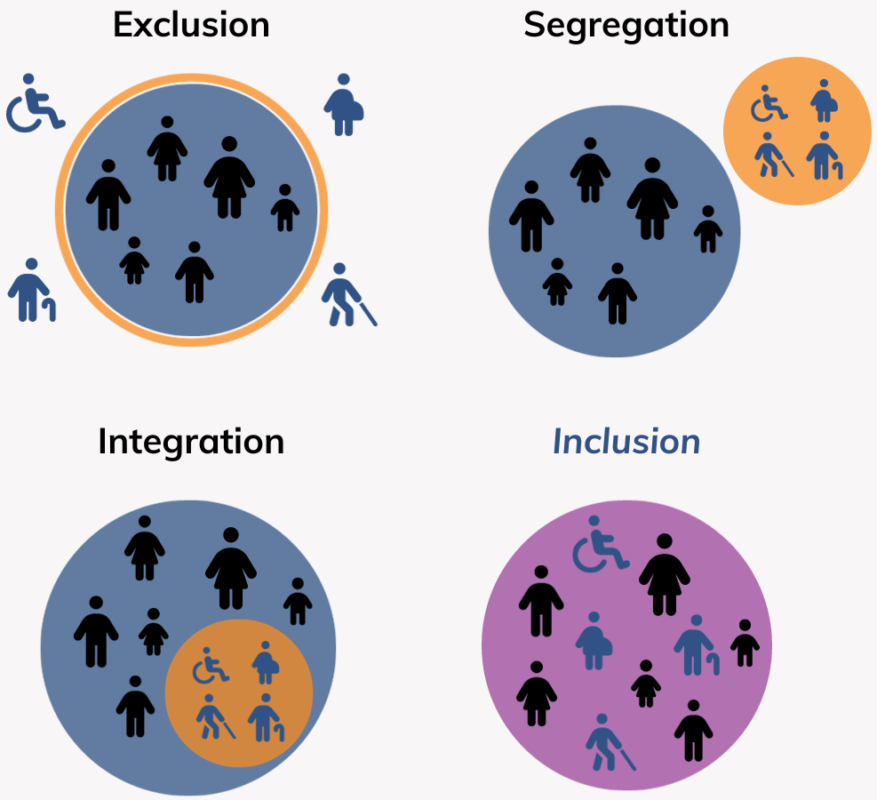
Emma became an inclusion teacher in BPS in 2013 and joined their Boston Teachers Union (BTU) Inclusion Committee in 2017. Inclusion teachers (IT) work in inclusive classrooms (IC). IC "ensures that students with disabilities are held to high standards and given access to more opportunities”. They consist of a proportioned number of students with and without disabilities. When Emma started working, there was typically one teacher with multiple, sometimes three, licenses and one paraprofessional for 20 students. There were up to 5 students with special needs integrated with able bodied students in each class. This design left educators feeling “ill-prepared and inadequate” because they didn’t have the support needed. Emma saw these structural conditions and feared parents and educators would develop a negative idea about inclusive classrooms. She saw the importance of inclusivity first hand with Micah, so she needed to make a change. Emma’s idea of inclusive classrooms was structured around these 3 questions: 1) Do students with disabilities and without disabilities have the support they need to grow academically and socially? 2) Do adults have the supports they need to meet students’ needs? and 3) Is the inclusion classroom promoting high expectations and a belief in what is possible?"
Emma took these questions and had conversations with other educators in her district. She identified racial inequities from them. “According to the National Council on Disability in 2018, students of color with disabilities are less likely to be in inclusive classrooms than white students. When the location of a school district is factored in, these statistics widen dramatically. These statistics were on loud display in Boston”. Emma was appalled by the injustices and racism around inclusion, which is why she joined the inclusion committee. She explained that “this committee’s initial work helped me, as a young teacher, to realize that unions could be leaders in the fight for inclusive education".
Emma saw firsthand the shift that teachers unions have a more social justice approach meaning the teaching and learning conditions are priority, in addition to making sure all students have access to the schools they deserve. Previously, they were more service-driven meaning they focused on protecting wages and benefits. This shift is what led the BTU to form the Inclusion Committee instead of eliminating the inclusion classrooms entirely because the teachers were unsupported and stretched thin. The BTU gathered data to support the “specific demand to stop triple-certifying teachers as a cost-saving measure and instead put two teachers in each inclusion classroom to meet student needs“. The teachers wanted to be an end to limitations from those without resources or privilege. The believed "inclusion done right would be the expectation for all kids, especially students of color and others often excluded”.
The movement was called Inclusion Done Right (IDR) and it had several small victories in the 2019 contract negotiation; but made big waves for future changes. For example, students who required English learner services now had to have support from another teacher besides their triple-certified classroom teacher, and those who had resource room minutes in their IEP must also have their minutes met from a teacher other than their classroom teacher. As momentum built from the IDR campaign, the BTU meetings in 2019 and 2020 gained a lot of popularity. In a room with 75 seats, each was taken by a staff or family member. The meetings offered interpretive services and childcare, making them more accessible than ever. Then, the pandemic hit and the tragic story of George Floyd scoured the nation. The BTU began a new campaign under the IDR, "Building an Anti-Racist Union". called for the removal of cops in our schools, the inclusion of ethnic studies curriculum, making the Black Lives Matter at School Week of Action part of the job description of building reps, keeping a union Truth and Reconciliation Committee to address racism that has persisted in the union for generations and healing, and creating a statement about the Inclusion Done Right campaign“. The campaign was successful and was passed in its entirety.
In response to the approval, BTU member Natalia Cuadra-Saez said, “when BTU members voted to pass the Resolution for Building an Anti-Racist Union it felt like a historic moment. To me it’s part of a historic shift that is happening within the labor movement. More and more unions and rank-and-file members are embracing a social justice unionism model. We’re acknowledging as union members that our goal is not just to fight for economic justice, but also for racial justice and social justice as a whole. To include demands from the Inclusion Done Right campaign is part of that acknowledgement. Inclusion Done Right is a civil rights issue. Inclusion Done Right is a racial justice issue. And if we want to build an anti-racist union we know that we can’t just use buzzwords or wear a sticker. We need bold demands that tackle the systemic inequalities our members, students, and families deal with on a daily basis. Inclusion Done Right is one of those bold demands". This statement, and entire article, was incredibly powerful.
This article relates to all of the topics we have discussed this semester but I couldn't help but see the similarities with the movie we watched last week, Precious Knowledge, and the DEI articles. I fear I see a trend about to happen. The ethnic studies classes were taken away from the students in Tucson Arizona despite their tremendous success. It was a huge step backwards. I worry that with what's going on with DEI, that same will happen with special education. The progress that has been made is too important to revert from.
Friday, June 6, 2025
Reflecting on The Academic and Social Value of Ethnic Studies
Christine E. Sleeter's research review on The Academic and Social Value of Ethnic Studies really drove home some of the topics we have discussed in class, especially the silenced dialogue in America, and the impact these topics have on our education system. For example, the elephant in the room introduced by Johnson relates to the avoidance of racism discussions in the classroom Sleeter is addressing. She states "students posited that teachers avoided in-depth discussions of race and racism out of fear that the Black students would react violently". This confirms the deep rooted segregation and prejudice within our society and educational system.
Additionally, I saw the alarming representation of white privilege throughout this entire article. Sleeter states "informal discussions with White adults suggest that they base their evaluations of textbooks on comparisons with those they used when they were in school, rather than on comparisons with ethnic studies literature (which most White people have not studied)". It is sad that despite the publishers efforts in the 1970's and 1980's to make textbooks more inclusive, educators are still reverting back to what they are comfortable with. Are educators not aware that the curriculum standards prevented further representation of inclusive experiences and world views? Do they not see that the system is broken and isolating?
Lastly, I really love the concept of ethnic studies and "allowing for multiple voices to enter dialogue constructing the narrative of this country". According to the 2023 U.S Census report, Whites alone make up 60.5% of the population. That means almost half of the population is diverse. How can the educational system deny the acknowledgement of other races and allow White's to continue to dominate story lines? Furthermore, "ethnic studies is curricula are academically based, usually designed to improve students' academic performance, and sometimes explicitly focus on university preparation". This mission should be what all educational curriculum is focused on. It's so disheartening to see the disconnect and division when the proof and research is in the pudding!
The author, Christine E. Sleeter, argues that ethnic studies is successful because intentionally designed to engage students and foster post-graduation preparedness due to offering a multicultural curricula that allows students of diverse backgrounds to feel seen and heard, as opposed to the traditional Euro-American studies curricula.

Monday, June 2, 2025
Reflecting on DEI
As I read the White House Executive Order on DEI and Full End of DEI EO by the White House and DEI Explained by Amalea Smirniotopoulos, I really was at a loss for words. I still am. 
The Civil Rights Act of 1964 set forth a crucial piece of legislation designed to outlaw discrimination and segregation based on race, gender, color, religion sex or national origin. Over time, additional federal laws such as the Americans with Disability Act were put into place to support, protect and expand upon these disparities. The Diversity, Equity and Inclusion (DEI) is a concept that also emerged. The core components of DEI are easily represented by the definition of each word. Diversity: Ensuring representation of diverse identities, including race, gender, and ability. Equity: Providing fair access to resources and opportunities, tailored to individual needs. Inclusion: Building environments where everyone feels respected, supported, and empowered. Overall, DEI initiatives, programs and policies were created to promote an inclusive and equitable workplace.
The first EO produced by President Trump is an order to end DEI and its funding in the federal government with the purpose of serving the American citizens with dignity and reducing taxpayer resources. The second EO states that DEI and DEIA goes against the Civil Rights of Americans and order to end illegal preferencing and discriminating in the workforce to allow individual merit to be considered. In contrast, the article explaining the EO's reminds us that equal opportunity and discrimination is still protected under the Civil Rights Act and not through these EO's, but that removing them will do our economy, national security and democracy a major disservice.
As I did the readings, I felt they were very biased and more importantly, I felt as though I was tangibly holding the definition of white privilege and culture of power. The first EO by President Trump blatantly bashed President Biden's Administration. It felt ugly and unprofessional. It doesn't matter whether his term was effective or not, President Trump should not be criticizing his colleague to further segregate parties. His terminology throughout both of the orders was bold, to say the least. Something only a white, upper class, male could produce without repercussions.
But then, the explanatory article gave me a similar feeling. The article states Trump's orders are "spreading disinformation and distorting federal laws to advance an agenda based on division and hate" but then concludes it by saying "these EO's will weaken our economy, endanger our national security and threaten our multi-racial democracy". I feel these are also bold statements to make and add to the fear mongering that Trump is executing. Who is right here? Can they both be? To me, it felt like Trump's EO and the explanatory article further divide our nation.
On one hand, I feel I can't be naive to believe that these policies have been completely effective since discrimination and segregation is still a major issue in our society. It's what we have been learning about the past few weeks, and what many fellow classmates have shared they personally experienced their entire lives. My controversial thoughts felt validated when when I read "a 2020 study by Citi estimates that the United States' aggregate economic output would have been $16 trillion dollars high since 2000 if we had closed racial gaps in wages, access to higher education, lending and mortgage access". Another striking quote I read states, "the American Dream is not equally available to all". We can all agree and be thankful for the fact that America has come an incredibly long way since the Civil Rights Act was established six decades ago, yet something still isn't working. On the other hand, it's scary to think about what our economy would be like had these policies not been set forth. I guess it's something we are going to find out very soon now that provisions and orders have been implemented. It's just disheartening to know that we need policies like this because people just can't be fair to one another.
I found a clip from The View that I feel explained my feelings and ideas on this topic very well. I don't watch the show they're referencing but I can relate to every woman who spoke. The link is here.
Subscribe to:
Posts (Atom)
-
Colorblindness is the New Racism by Margalynne J. Armstrong and Stephanie M. Wildman discusses the importance of shifting our terminology fr...
-
As I read Other People's Children by Lisa Delpit, I felt a sterner tone than what has been expressed in the previous readings. Delpit w...
